
How Schools Can Build a Proactive Student Safety System
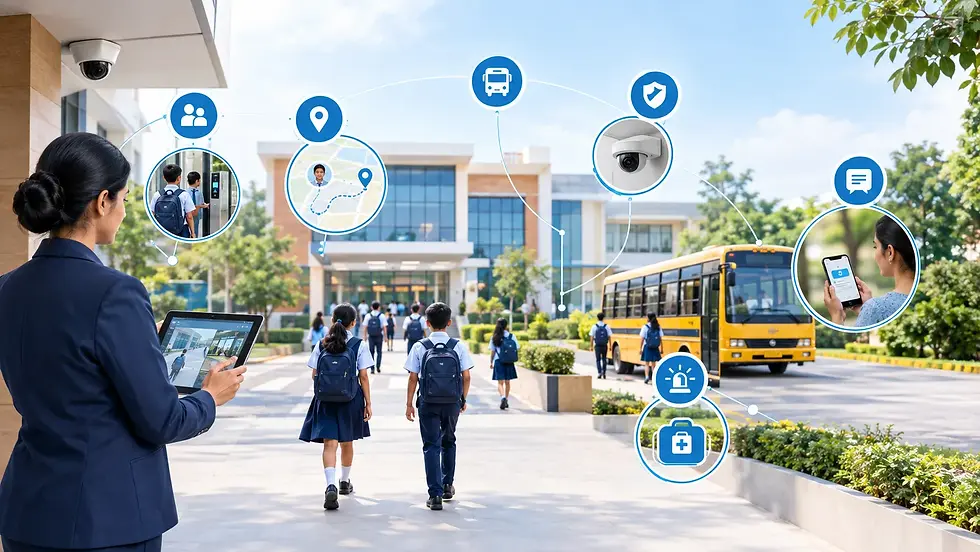
The traditional approach to student safety in schools has been to react to problems after they occur. The student could be marked absent after missing class, the parent could be notified when something goes wrong, or the school staff could review an incident after the fact.
But school safety is slowly moving to a new way of thinking: proactive, not reactive.
“A proactive student safety system isn't about forecasting every incident that may occur. What it means, instead, is building systems that keep schools informed, identify risks sooner, improve communication, and provide better visibility across a student’s school day.
Technology is increasingly contributing to making this possible.
Moving From Reactive to Proactive Safety
A reactive safety system typically starts with an incident. An incident occurs, and the school responds.
A proactive system is something else. It creates processes that continuously deliver relevant information to teachers, administrators, transportation teams and parents.
For example, it can help schools be more aware all day long by knowing if students have arrived at school, keeping accurate attendance records, monitoring school transportation, and controlling visitor access.
“We don’t want to be over-monitoring students. It's about getting important safety information to people at the moment they really need it.
1. Using Technology for More Reliable Attendance
Attendance is one of the first things you check in a student’s school day.
Teachers may have to call names and enter information manually with traditional attendance methods. In a busy classroom this can take time and may also create opportunities for mistakes.
Digital attendance systems can make the process easier and more structured. Technologies such as facial recognition and automated attendance can aid schools to record attendance more efficiently while reducing repetitive administrative tasks.
More importantly, digital records can simplify access and management of attendance information for authorized school personnel.
This means attendance can be more than just a classroom exercise; it can be a part of a larger student safety system.
2. Creating Better Visibility During School Transportation
For many students, the journey to school starts before they even step into the school building.
School transportation thus needs to be viewed as part of the overall framework of safety.
Schools can also use GPS-based bus tracking to give real time information on vehicle locations. Another layer is geofencing, which creates a specific geographic boundary around routes or locations.
This could support transport teams to understand where busses are during a journey and identify situations that need attention.
Parents also benefit from better visibility into the school transportation process when information is shared through proper school communication channels.
The aim is not simply to follow a vehicle. It seeks to raise awareness on an important part of the student’s daily journey.
3. Strengthening Visitor Management
Schools are shared spaces, and students, teachers, staff, parents, vendors and visitors may come onto the premises.
Manually controlling this flow can get challenging especially in bigger schools.
Digital visitor management systems help schools to track the visitors in a more organized way and make the process of verifying the visitors to the school campus easier.
Schools can use technology to keep a more organized record of visitor entries instead of just a paper register.
This can help authorized staff better understand who is on campus and help create a more controlled school environment.
4. Improving Student Dispersal and Pickup Processes
The campus is usually most active at the end of the school day.
Students may be leaving the classroom, busses may be lined up for departure, and parents or other authorized guardians may be arriving for pick up. If there is no system, this time can be difficult to manage.
Schools can use technology to put in place structured systems for student dispersal by keeping track of relevant data about students and their authorized pick-ups.
“With attendance, student records and pick up processes all linked together, staff can spend less time cross-referencing multiple manual records and more time managing the actual movement of students.
5. Connecting Parents and Schools
Student safety is not just what happens in the school.
Parents need a reliable way to communicate with schools. Schools need an efficient way to communicate important information to families.
Digital communication systems can remove the need for sporadic messages, paper notices or manual telephone calls.
When important information is accessible through a centralized system, parents and school staff can better understand what is important in a student’s school day.
But technology should not substitute for human interaction but rather assist communication. Schools still need teachers and staff who can read the situation and react accordingly.
6. Using Data to Identify Patterns
One of the less obvious benefits of digital safety systems is the ability to see patterns over time.
For example schools may experience repeated delays on one transport route, frequent attendance irregularities or recurring issues at particular points of the school day.
When digitally recorded, patterns can be reviewed by administrators instead of depending on individual incidents or memory.
This is good for schools to ask better questions:
Where are the problems recur?
When are they occuring?
What processes can be optimized?
In this way, data can support preventive decision-making.
7. Technology Still Needs Human Oversight
Schools shouldn’t be relying on technology alone in a proactive safety system.
Facial recognition, GPS tracking, digital records and automated systems can help provide information, but they can’t replace responsible adults.
Schools also need clear safety policies, training for staff, emergency procedures, privacy safeguards and control of access.
Students’ data should be carefully managed, especially when technologies gather personal or location information. Schools need to think about what information they actually need, who will see it and for how long they should keep it.
The most effective approach is therefore not technology versus people, but technology supporting people.
Building a Connected Safety Environment
Student safety is about being proactive, and the system works better when the processes are connected, not separate.
Attendance, transportation, visitor management, communication, student records, and dispersal are also more impactful when integrated into a coordinated school safety framework.
It’s not the goal to create a school where everything is monitored all the time.
What we want to do is build a school where the right information gets to the right people at the right time so that staff can respond sooner and manage the day-to-day processes better.
As schools embrace electronic devices, so too is the definition of student safety. It's not just emergency response anymore. It increasingly covers prevention, visibility, communication, organization and making informed choices.
visibility, communications, organization and informed choice-making.
MyKawach features are built on these areas and integrates school processes like attendance, student tracking, transportation, geofencing, visitor management, parent-school communication etc.
At the end of the day technology is just one piece of the school safety puzzle.
The bigger picture is to develop systems that make schools more organized, more aware and better prepared so that student safety is an ongoing process and not something that is addressed only after a problem arises.


Comments